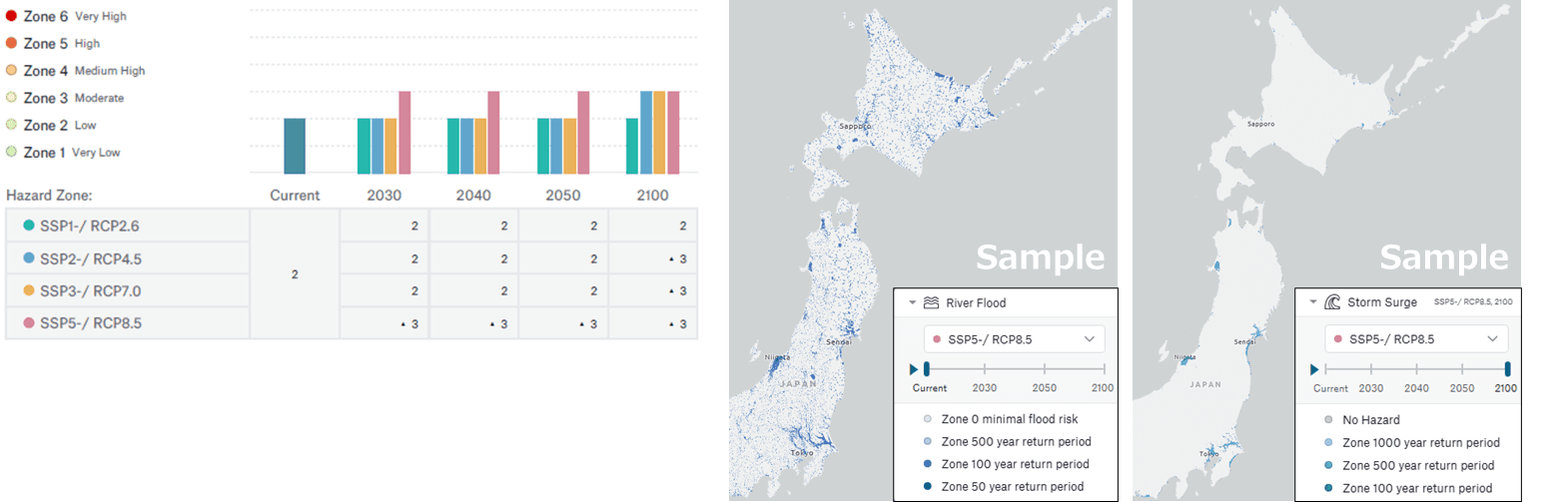
Capturing the increasing risks associated with rapidly changing climate environments.
Due to the progression of climate change, there are concerns that natural disasters such as heavy rains and typhoons will become more frequent and larger in scale than ever before. Our company can present these future natural disaster risks in a visual and easy-to-understand format.
Future risk levels will be assessed based on internationally widely used climate change scenarios such as SSP (Shared Socioeconomic Pathways) and RCP (Representative Concentration Pathways). Assuming an average temperature rise of 2°C or 4°C from the present, multiple scenarios can be used to examine the potential scale of natural disasters such as heavy rains and typhoons at several future points in time, such as 20, 50, and 100 years from now. This allows for a scientifically-based understanding of future natural disaster risks, which can then be used for planning and risk mitigation to ensure the long-term and safe continuation of business operations.
Furthermore, when reviewing insurance policies, assessing the impact of climate change is a valuable tool for determining premium levels and coverage. By utilizing reliable paid information services from overseas, we can visualize and compare current risks with future risks that take climate change into account, thereby clearly identifying risks that should be prioritized.